

Sep 15, 2026
3 mins read
Future of Work
When we hear “3× increase in full-day bookings” that sounds pretty compelling.
And it is.
But there’s another figure in the Flexspace AI full-day meeting room data that I think is even more important: 1 of 8. That’s the number of full-day customers who come back and book again within 90 days.
And it hasn’t meaningfully moved for four consecutive quarters.
That’s important because growth from acquiring new customers is fundamentally different from growth that compounds through repeat behavior.
Over the past year, full-day orders grew 160%, while full-day revenue grew from 156%. Average order value stayed essentially flat at $837.
The data doesn’t tell a story about simply raising prices. It tells a story about bringing significantly more customers into the funnel.
But our data shows that 88% of that trailing-twelve-month revenue came from domains making their first-ever full-day booking during the period.
In other words, the demand is present, and coworking space operators are doing a very good job of getting new customers through the door.
The bigger question is: what happens next?
The second booking changes the economics
Because the economics of the second booking are compelling.
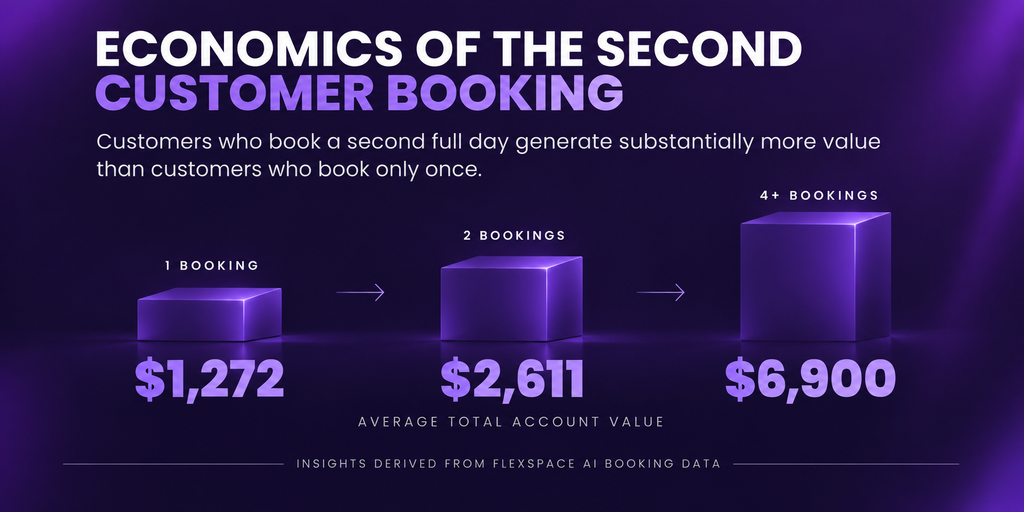
Customers who book a second full day generate substantially more value than customers who book only once. Total account value rises from about $1,272 after one full-day booking to $2,611 after two, and continues climbing from there. Customers booking four or more full days have an average total account value of nearly $6,900.
And that doesn’t include just full-day bookings; 35 percent of these accounts’ total spend comes from other products, including hourly meeting rooms and day offices.
So the first booking isn’t necessarily the product. It’s the beginning of the customer relationship.
And that changes the growth equation.
If an operator spends all of their energy finding the next new customer, they have to keep starting from zero.
But if that first booking creates a path to a second booking, and then a third, the economics begin to compound.
The data suggests we have a meaningful opportunity here.
The median gap between a customer’s first and second full-day booking is 43 days, yet there really hasn’t been a mechanism specifically designed around that moment. That’s why we launched our SmartMarketing Agent.
And that right there is the metric I’d be watching.
Because the only question to ask isn’t just “How many new customers did we acquire?” It should also be: “How many customers did we give a reason to come back?”
And then: “What are we doing to nurture our returning customers?”
Because 3× growth is great. But compounding growth is better.