


Sep 22, 2026
4 mins read
Future of Work
There’s a common assumption in flexible workspace: if you have the right rooms, the demand will follow.
But Flexspace AI data suggests something more interesting.
The same inventory can produce very different results depending on how it’s packaged and sold.
Across the Flexspace AI network, 1 out of 8 meeting room booking are full-day bookings, and that currently accounts for 11.4% of meeting-room revenue.
But that average hides a remarkable range.
With some of our partners, full-day bookings account for almost none of their meeting-room revenue. At others, they account for more than 20%. The highest-performing partner generates
37% of meeting-room GMV from full-day bookings.
And these partners aren’t necessarily operating with fundamentally different inventory.
So the question can’t simply be, “Do customers want full-day workspace?” because they clearly do.
Flex operators need to examine how they’re positioning their spaces to maximize revenue.
Now, they’ve traditionally been very good at selling inventory. A meeting room has a capacity, an hourly rate, amenities and availability. So, when you put those details on a booking page and let the customer choose.
That works when the customer already knows what they want.
But a full-day booking is often less about the room and more about what the customer is trying to accomplish.
A team might need a quarterly planning day. An offsite. A training session. A leadership meeting. A day to bring a distributed team together.
The room is what they book. The occasion is what they’re buying.
And our data suggests the partners generating the highest share of full-day revenue aren’t necessarily winning because they have fundamentally different inventory. They’re winning, at least in part, by packaging that inventory differently, which creates an interesting opportunity for operators.
Instead of asking a customer to figure out which room they need, what if operators started by helping them identify why they need the space? Is it a team day? A quarterly planning day? A Monday kickoff?
The room, AV, and all the other essentials can become part of simple packages built around occasions.
To be clear: the goal isn’t to add complexity. It’s actually to make the buying decision easier.
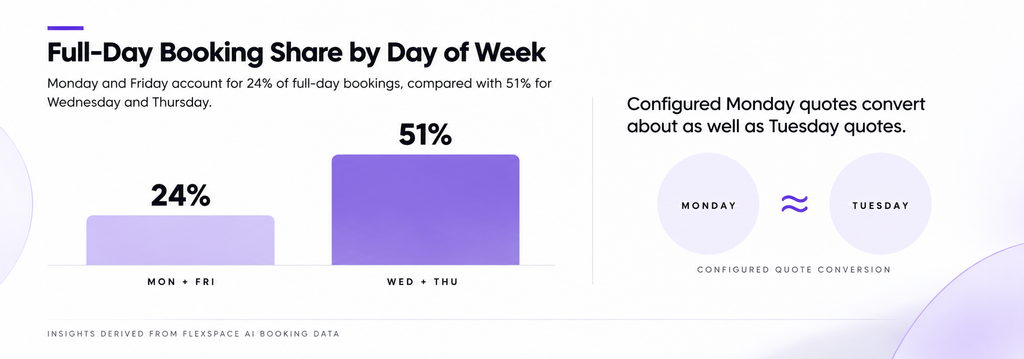
Let’s look at the data from underutilized days. Monday and Friday account for just 24% of full-day bookings, compared with 51% for Wednesday and Thursday. Yet configured Monday quotes convert about as well as Tuesday quotes.
That suggests this isn’t simply a demand problem.
If we look at this data as a potential packaging problem, operators can shift some of their focus on connecting the inventory they already have to the occasions customers are trying to solve.
Instead of: “Here’s a room. Here’s the hourly price. Here’s when it’s available,” the booking descriptions say… “Here’s what your team is trying to accomplish. Here’s the space that fits. Here’s what’s included. Here’s the price.”
This makes the buying decision easier, and signals an important shift for the industry. Because the next wave of flexible workspace growth may not necessarily just come from building more rooms.
Operators need to look at selling the rooms they already have differently.