

Sep 1, 2026
4 mins read
Future of Work
What do Microsoft, Meta, Salesforce, LEGO and Airbnb have in common?
Well, their teams are booking workspace for the same reason: they need to get people in a room together.
At first glance, these companies are rather different – in industry, size, business model, even workplace strategy.
But when you look at how specific teams actually use flexible workspace, an interesting pattern emerges: the company may be the customer, but the team is the unit of demand.
The flexible workspace industry has spent years thinking about customers in familiar categories: startup, SMB, and enterprise. And they’ve also focused on selling office memberships versus on-demand meeting rooms.
And for the most part, it makes sense.
Company size is easy to measure, easy to segment, and easy to build a sales strategy around. Memberships offer consistent revenue.
But a deeper dive into Flexspace AI full-day booking data suggests something else: that company size may not tell us as much about workspace demand as we think.
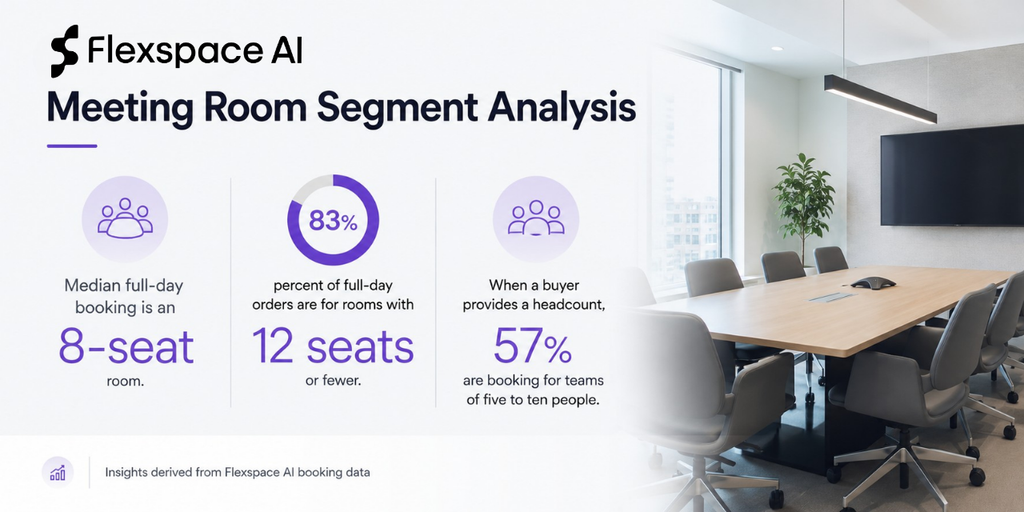
In our analysis, we discovered that median full-day booking is an 8-seat room, and 83% percent of full-day orders are for rooms with 12 seats or fewer. And when a buyer provides a headcount, 57% are booking for teams of 5 to 10 people.
And here’s the part I find most interesting: that pattern doesn’t materially change as the company gets bigger.
So, a 40-person startup and a company like AstraZeneca aren’t necessarily looking for different workspace products.
The enterprise may have more teams that need the space, and therefore more occasions to book it, but the underlying need is remarkably similar and straightforward:
A team needs to get together.
But here’s the thing: that basic need should challenge how we think about the flexible workspace opportunity.
If we define the customer primarily by company size, we tend to build around the assumption that an enterprise needs a fundamentally different product than a startup.
But if we define demand around the team, operators can start asking better, more pertinent questions (and designing their booking pages and experiences) to bring customers closer to the purchase decision.
With so much focus on the office use case, operators are repeatedly missing out on the meeting room opportunity.
And the Flexspace AI booking data reinforces that.
From our data, the majority of full-day bookings happen Tuesday through Thursday, and the most common reasons customers give are team meetings, planning sessions and offsites. The median lead time is about ten days.
With that in mind, you can infer that demand isn’t necessarily coming from the company as a whole, but rather a team with a specific need, at a specific moment.
And that distinction matters.
A large enterprise may have thousands of employees, but workspace demand doesn’t come from all of them at once. It comes from individual teams: a product group planning a launch, a marketing team holding an offsite, a leadership group getting together for the day.
The company may be the account.
But the team is the actual demand.
For flexible workspace operators, understanding that difference means thinking less about the size of the company and more about the teams, and their specific needs that actually drive them to discover and convert. Because the opportunity isn’t simply to sell more space to bigger companies.
It’s to become the place their teams turn to whenever they need to get together.